How I use ChatGPT Health with my real medical records
The dashboard is nice, but it isn't the point. ChatGPT Health connects to your actual medical records, so you can ask hard questions without retyping your history or pasting in labs.
I have stage 4 ALK-positive lung cancer. That comes with a lot of labs, a lot of medications and a lot of appointments where I'm trying to remember what changed, and when. For a long time, using AI for my health meant copying lab values into a chat box and retyping my whole history, every single time. It worked, sort of. It was also exhausting, and it's the last thing you want to do on a bad day.
ChatGPT's Health feature changed that for me. You connect your actual medical records, and then you just ask.
This is my personal experience. I'm a patient, not a doctor, and none of this is medical advice.
The dashboard isn't the point
Health has a dashboard with your labs and trends. It's nice. It's not why I use it.
The value is that ChatGPT already has your records when you ask a question. You don't have to explain who you are, what you take or what your numbers were last spring. You skip the setup and ask the hard question you actually have.
What happened when I asked about my cholesterol
I gave it no context. I asked one question: how has my cholesterol changed since my cancer drug switch?
It pulled my labs on its own. It marked the drug switch and the statin my doctor added, and it drew me this chart.
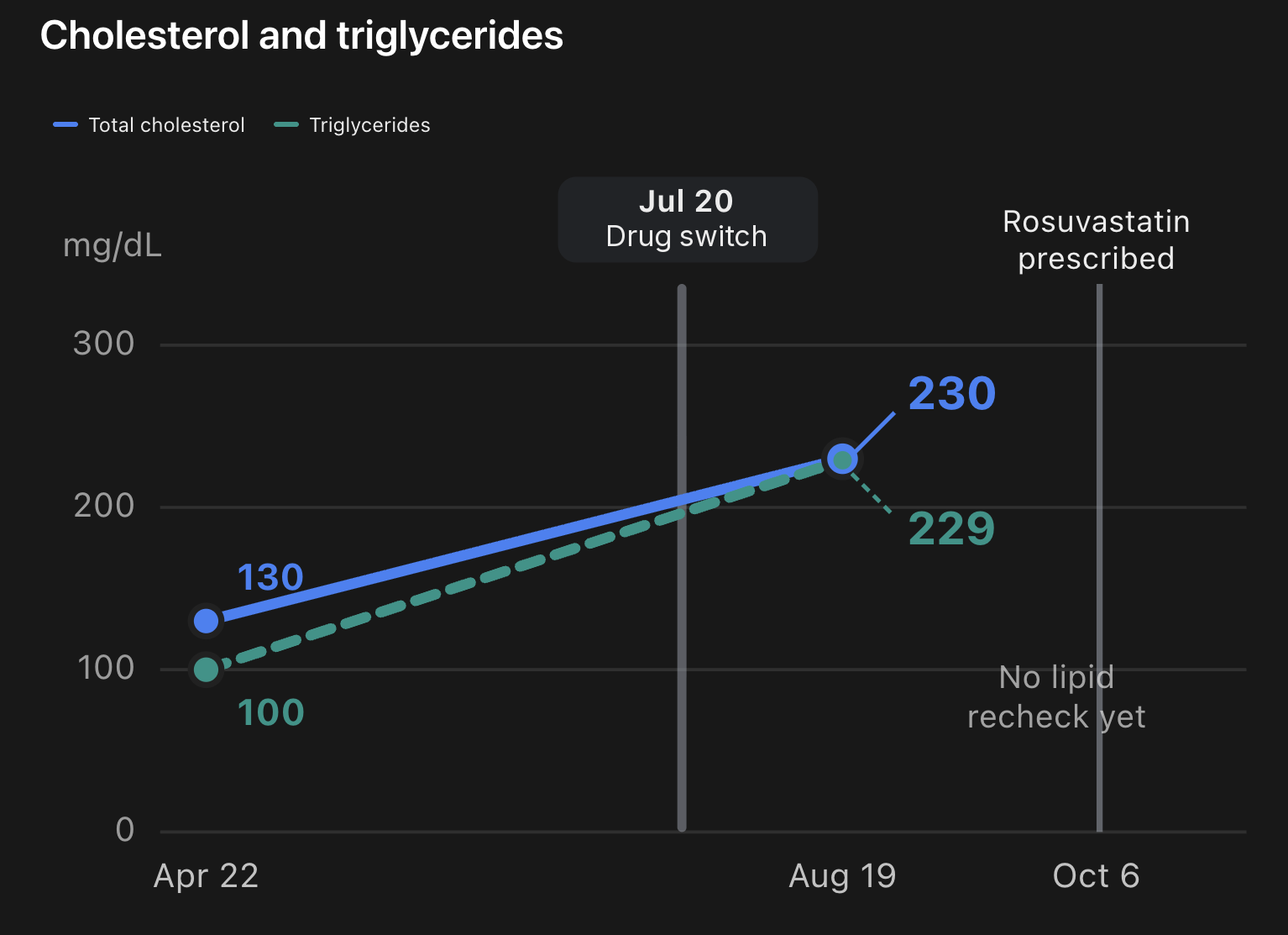
From April 22 to August 19:
- Total cholesterol went from 130 to 230.
- Triglycerides went from 100 to 229.
- LDL went from 72 to 156.
Then it pointed out something I hadn't put together. My doctor prescribed rosuvastatin 20 mg on October 6, and there hasn't been a recheck since. It gave me the question to bring to my next visit.
That's the moment it clicked for me. My care team had already caught the change and acted on it. What I got was a clear picture of my own numbers, in about a minute, plus one useful thing to do next. I didn't paste a single lab value.
Setting it up
Honestly, it's easy. It's all inside the ChatGPT interface. You log in to your patient portal (mine is MyChart) and that's that.
A few things OpenAI's own pages say, as of October 27, 2026:
- It's for logged-in users 18 and older in the U.S., on the Free, Go, Plus and Pro plans. It's still rolling out, so you may not see it yet.
- It's supported on the web and in the iPhone app.
- You open Health from the ChatGPT sidebar to get started. If your provider isn't listed, OpenAI asks you to request it through its Help Center with just the provider's name (no medical information).
Who this is for
- People managing a chronic illness. If you have years of labs, a long medication list and more than one specialist, this is where it shines.
- People managing someone else's care. If you're the one keeping track for a parent, partner or kid, you know how much of the job is just finding things. One catch: OpenAI says the connected Health experience is meant for your own records. For someone else's, it suggests a separate account, or a separate project with project-only memory and uploaded files. Get their permission first.
Questions worth asking it
Swap in your own labs and medications:
- How has my [lab] changed since I started [medication]?
- What changed in my labs since my last appointment?
- Explain my latest visit notes in plain English.
- Which of my results are outside the normal range, and for how long?
- Is there a follow-up test or recheck I should ask about? (That's the kind of gap it caught for me.)
- What should I ask my doctor at my next visit, based on my recent results?
- Make a one-page summary of my current medications and recent labs to bring to my appointment.
The limits
- It isn't a doctor. OpenAI says Health is meant to support medical care, not replace it, and it isn't for diagnosis or treatment.
- It can be wrong. Records can be incomplete or out of date. OpenAI's own example is a medication that stays on the list after you stop taking it. Check anything important against the original result in your portal.
- Take its questions to your care team. The best thing it gives me is a better question for my doctor. Never start, stop or change a medication because of a chat.
- Decide what you're comfortable sharing. OpenAI says connected records, and the conversations that use them, aren't used to train its foundation models or target ads. It also says that if you disconnect an account, the synced data is deleted within 30 days, while past conversations stay until you delete them. Read the details and make your own call.
Why it's my go-to for health right now
This is just my opinion. The frontier AI tools are all impressive, and they're all getting better fast. For health, right now, ChatGPT is ahead for me, and the reason is simple: it can see my actual records. That changes the kind of questions I can ask. If that changes, I'll update this page.
- Get your reports, raw data and sample details
- Use AI to do the paperwork and research
- AI and your care
I'm not a doctor and this isn't medical advice. It's what's working for me. Please talk to your care team before you change anything.