Test your home for radon
I was diagnosed with stage 4 lung cancer in July 2024, and I never smoked. Nobody knows what caused it, but radon is a leading suspect. Testing your home is cheap and easy. As of November 2026, fixing mine had cost about $1,000.
I was diagnosed with stage 4 lung cancer in July 2024. I never smoked. Not even a cigarette on a drunk night out.
Nobody knows the true cause. Radon is a leading suspect.
Radon is a radioactive gas that seeps up from the ground and can build up inside your home. You can't see it, smell it or taste it. The only way to know your level is to test.
Why this matters for everyone
This isn't just a lung cancer patient thing. If you live in a home, it's you, your kids and everyone else under that roof.
- It's the top cause of lung cancer in people who never smoked. That's EPA's estimate. Overall, radon is second only to smoking.
- About 21,000 lung cancer deaths a year in the US, according to EPA. About 2,900 of them are in people who never smoked.
- It's worse if you smoke. A smoker exposed to radon has a much higher risk.
EPA and the Surgeon General recommend testing all homes below the third floor.
Step 1: Check your county's zone
EPA's Map of Radon Zones colors every county by its radon potential:
- Zone 1 (red): highest potential. Average indoor levels may be above 4 pCi/L (picocuries per liter, the unit radon is measured in).
- Zone 2 (orange): moderate. Average indoor levels may be between 2 and 4 pCi/L.
- Zone 3 (yellow): low. Average indoor levels may be below 2 pCi/L.
If you're in a red zone, don't wait. But the map can't tell you about your house. EPA says homes with high radon have been found in all three zones, so test no matter where you live.
Step 2: Test your home
Test kits are cheap and easy. You can buy them online or at a home improvement store. EPA points to discounted kits from the National Radon Program Services at Kansas State University, and some states give them out free or at a discount through their state radon program.
There are two kinds of tests:
- Short-term tests stay in your home for 2 to 90 days. They're quick, but radon changes day to day and season to season, so one short test is less likely to show your year-round average.
- Long-term tests stay in for more than 90 days. They give a better picture of your year-round average.
A few tips from EPA's guide:
- Put the kit in the lowest level of the home you actually live in, like a basement you use or the first floor.
- Use a room you spend time in, not the kitchen or bathroom, at least 20 inches off the floor and away from drafts.
- For a short-term test, keep windows and outside doors closed as much as you can. For a 2 or 3 day test, close them 12 hours before you start.
- When it's done, seal it up and mail it to the lab right away.
EPA's order of operations: start with a short-term test. If it's 4 pCi/L or higher, follow up with a long-term test, or a second short-term test if you need an answer fast.
Step 3: Fix it at 4 pCi/L or higher
EPA says fix your home if your level is 4 pCi/L or higher, and consider fixing between 2 and 4. EPA also says no level of radon is completely safe. For comparison, the average indoor level is about 1.3 pCi/L.
The usual fix is simple. It's piping under your house with a fan that pulls the radon out and exhausts it above the roofline, instead of letting it slowly trickle up through your home. EPA calls it soil suction, and says some systems can cut radon levels by up to 99%.
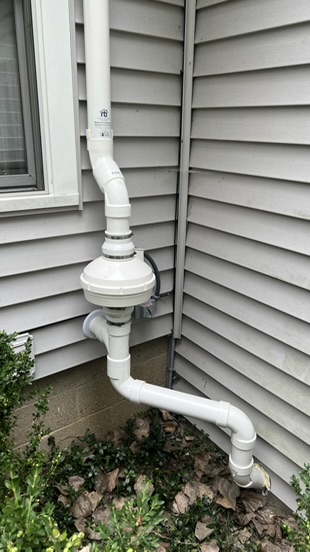
As of November 2026, my system had cost me about $1,000. Someone handy can probably do it for less. EPA says most homes can be fixed for about the same cost as other common home repairs, and that costs vary a lot, so get more than one estimate.
If you hire someone:
- Ask your state radon program for credentialed professionals. EPA says states list providers licensed by the state or certified by the National Radon Proficiency Program (NRPP) or the National Radon Safety Board (NRSB).
- Ask where the pipe and fan will go, and how you'll know the system is working. EPA notes most systems include a monitor.
- Test again after it's installed. EPA also suggests retesting every two years.
What testing won't tell you
Testing won't tell you what caused a cancer. Nobody can tell me that either. But it's cheap, it's easy, and fixing a high level protects everyone in your home from here on out.
Keep going
Links
- EPA Map of Radon Zones
- EPA: find a radon test kit or a qualified professional
- EPA: A Citizen's Guide to Radon (PDF)
I'm not a doctor, and this isn't medical or home inspection advice. It's what I learned and what I did.
Related on X
Follow @kevinace
What would you add?
Help make this page more useful.