Cancer just hit your family. Start here.
Get the reports, ask about tumor testing, find a specialist, and put the next steps in one place.
I have stage 4 ALK-positive lung cancer. These are the things I wish every newly diagnosed family knew to ask about. You do not have to learn all of oncology this week.
1. Get the exact diagnosis and the reports
Write down the cancer type, stage, known biomarkers, treatment so far and the next decision date. Get copies of the pathology, scan and molecular-testing reports. Keep the original files together.
Ask the treating team: “What needs to happen now, and what can wait while we get more information?”
Use the records request checklist.
2. Ask what tumor testing is missing
“Has my tumor had the biomarker testing recommended for this cancer? Does the testing cover DNA, RNA or other markers we need? Would more testing change a treatment decision?”
Tumor testing and inherited-risk testing answer different questions. A longer report is not automatically a better plan. Your cancer type, existing results, sample and timing matter.
If another biopsy is planned, ask about the tissue before it happens. Pathology and the receiving lab need to agree on what to save and how.
Testing questions · Tissue checklist
3. Get a second opinion from someone who sees your subtype
Your local oncologist can be excellent and another specialist can still add something. Ask about a consultation at a cancer center with experience in your exact disease.
Bring the reports, your current plan and three questions. Ask whether local care can continue with the specialist advising.
4. Check trials early
Start with the cancer type, the biomarker and where you can realistically travel. Then read eligibility, prior-treatment rules and the actual site’s recruiting status. A trial listing is a lead; the trial team decides whether you can enroll.
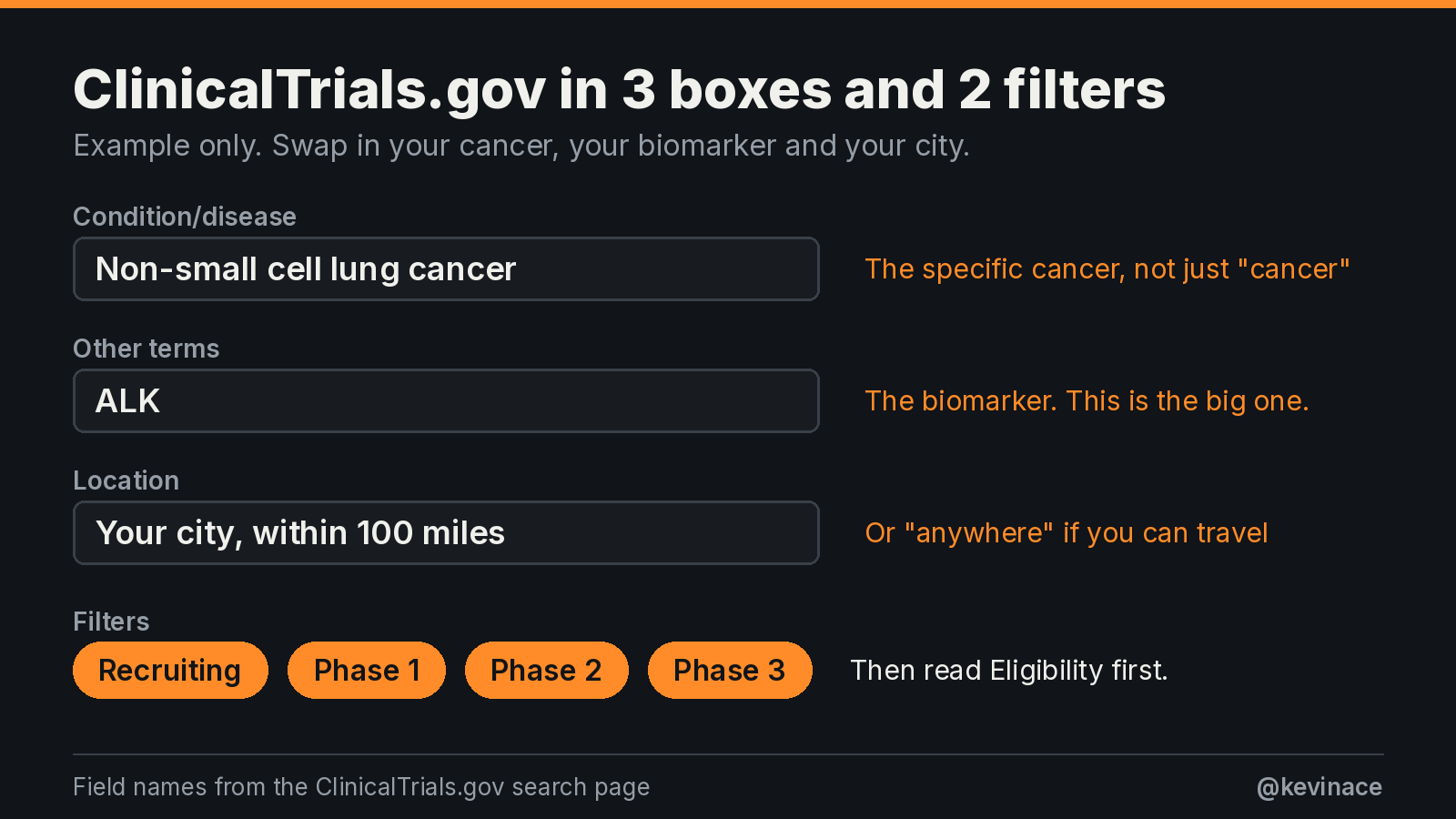
Example only. Replace lung cancer, ALK and the location with your situation. Phase filters can narrow a search; they are not a ranking of which treatment is best.
Build a useful trial shortlist.
5. Get help carrying the load
FCCT offers free research support. Disease-specific patient groups can point you toward specialists, practical experience and questions you did not know to ask.
Pick one person to track calls, records and open questions. Do not make every family member rebuild the same spreadsheet.
Find patient groups and support.
What about the vaccine I’m working on?
It is an experimental project for my cancer, not the first step for a newly diagnosed family. Start with the diagnosis, standard treatment options, testing and specialist input.