Ask AI about your data, not your symptoms
My resting heart rate jumped this summer and I assumed something new was wrong. One structured question over 3 years of my Apple Watch data showed my old cancer pill had been holding it down.
This summer my resting heart rate jumped to about 78. I assumed something new was wrong.
The tempting move is to ask AI "why is my heart rate high?" That's a symptom question, and it gets you a list of scary possibilities. I asked it about my data instead.
One structured prompt in ChatGPT Health went through 3 years of my Apple Watch data. It found something I never knew in thousands of hours of using AI: my old cancer pill, alectinib, had been holding my heart rate down.
What the data showed
- Before alectinib: about 66 bpm.
- On alectinib: about 61 bpm.
- After I switched drugs in July: about 78 bpm.
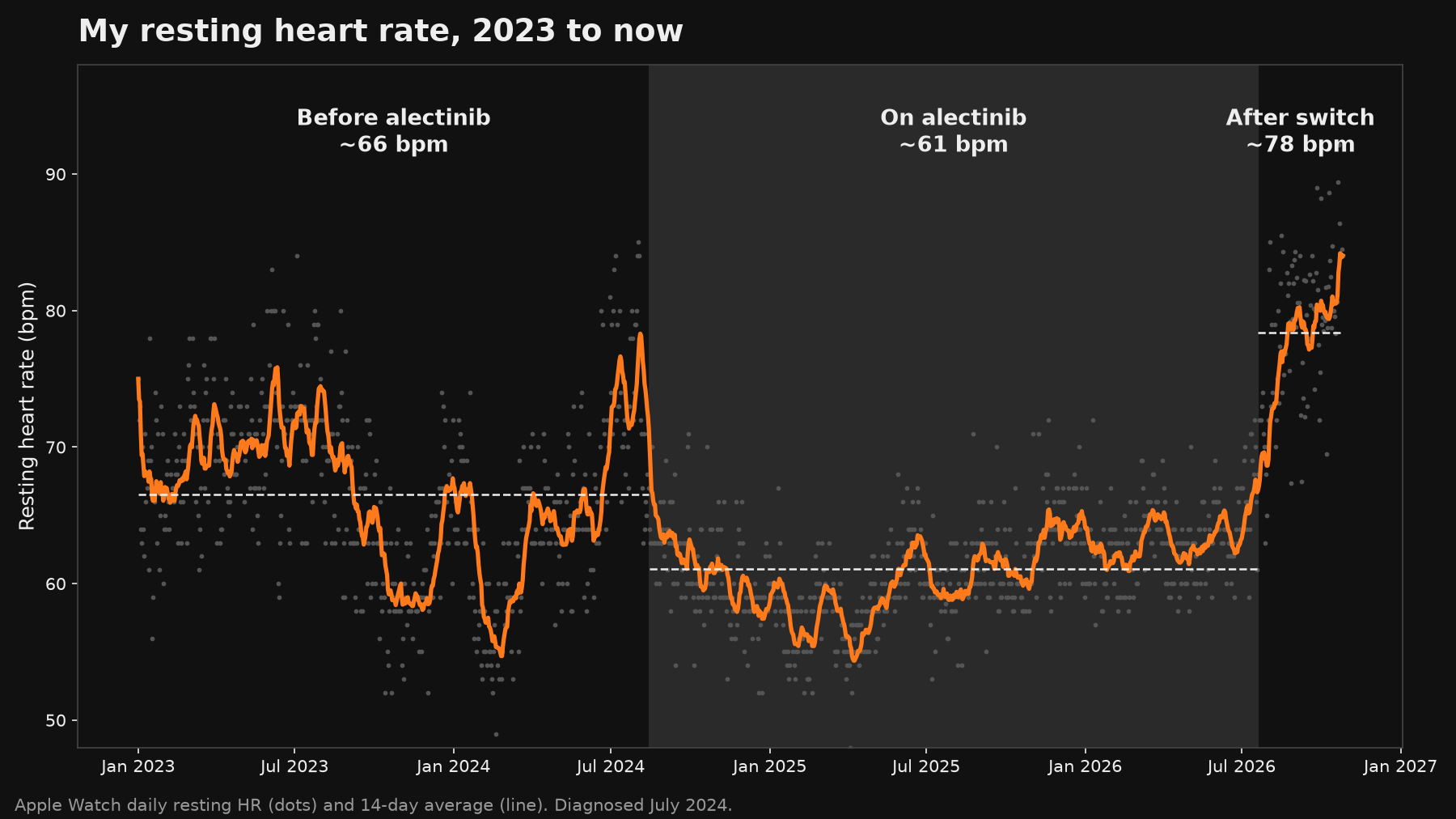
So part of that "spike" was just me coming off the drug. My heart rate was coming back up from where alectinib had been holding it.
Not all of it. My doctors are working on the rest. But I walked in with the right question instead of a panic.
It's not a wild guess, either. Alectinib's official prescribing information lists slow heart rate (bradycardia) as a warning. It occurred in 11% of patients, and 20% of patients with repeat ECGs had heart rates under 50 after a dose.
How to ask about your own data
- Connect the data. I use ChatGPT Health with my real records and Apple Health connected, so it can see years of readings, not just today.
- Ask about a change, with dates. Tell it when things changed: a new medication, a switch, a procedure. Ask what the data shows before and after.
- Make it separate evidence from guesses. My question asked it to separate what the data shows from what's plausible but unconfirmed. That's rule 6 of my 9 rules for asking AI about your health.
- Take it to your doctor as a question. Not a diagnosis. Bring the before and after numbers and ask what they mean for you.
If something new feels wrong, like chest pain or trouble breathing, call your doctor. Don't wait on a chart.
Your phone already has years of health data. It's worth asking it a good question.
Keep going
- Connect your real records with ChatGPT Health
- Give your AI a notebook so it knows your medication history and timeline.
- Ask AI about your health with rules, not open questions
- Get your reports, raw data and sample details
- AI and your care
I'm not a doctor and this isn't medical advice. It's what's working for me. Please talk to your care team before you change anything.